So what do you do if you have a festival in town?
Color the public fountain PINK*?–Oh Absolutely!

*Note: The fountain was pink for Breast Cancer Awareness week, not for the Halloween Festival.
So what do you do if you have a festival in town?
Color the public fountain PINK*?–Oh Absolutely!

*Note: The fountain was pink for Breast Cancer Awareness week, not for the Halloween Festival.
This write-up can be titled “You saw it HERE first” but we think that works better as a punch line. You’ll see why.
We also apologize in advance. Some parts of this post may be specific to a people in a time that you may not identify with. But that is the people & time that we are from. And this post is important to us.
So take yourself back in time to 1995. We were students of architecture, in a south asian setting. We learnt how to “live, breathe and dream” in the material. Drawings were hand-drawn and hand inked. Glass Curtain walls was not yet the norm; air conditioning rare; Raw untreated sewage was dumped in rivers. Many believed in sourcing and building local. Green Architecture was not a “brand”- it was the norm.
Forward to 1999: AutoCAD was introduced in architecture schools as the preferred medium of drawing. Few held out against the “mechanization” of the “art” of hand drawing. Others embraced it. We were somewhere in the middle. New technologies in building were introduced. Some held back and others embraced it. But raw sewage still found its way to rivers.
In such a time, where old ideologies were meeting the new, an idea was born. This idea was not special in the overall scheme of things. In retrospect, it was probably not even great design. But in a conservative society which was starting to question its conventional wisdom, this idea was trying to push the boundaries of its own circumstance.
An idea of a LIVING BRIDGE.
It was unheard of in India.
The technology to make it glamorous was not mainstream yet. So it stayed unglamorous and tried to do the best it could with what it knew.
This BRIDGE would try to connect a highly affluent/developed area of a city with its low-income area. It would try to make a city LOOK TOWARDS its river rather than treat it like a sewage drain. It would try to bring RESPECT to the river in the hope that future generations may enjoy its beauty. And it would try to be an Urban street in a city that was slowly forgetting its own street life.
This LIVING BRIDGE did not look like much, but it had great ideals for itself. It wanted to change the city and then change the world!
This idea was submitted to the then Environment/Urban Development authority.
And there it lay buried for years, waiting patiently.
In 2011, there are advertisements that a fabulous new “living bridge” will be built in a city in north India. This bridge will make the river’s waterfront a place to be. It will be shaped after the water side communities abroad. It will be GLAMOROUS, it will be GREAT and it will be BEAUTIFUL. It will make a statement to the world!
It is an idea whose time has come.
But remember, you saw it here first…:)!
New category that covers urban spaces everywhere. We should mention that for several years the design and use of urban space has been our daily bread. Why haven’t we posted that much about it, you ask? Because we want to look at things from a different perspective: one of art, one of the human scale, one of what catches the eye. In this process we realized that space is the same everywhere–inside and outside. Only the scales of construction are different.
The mark of any well designed space is that it blends into the background and allows interactions to take place.
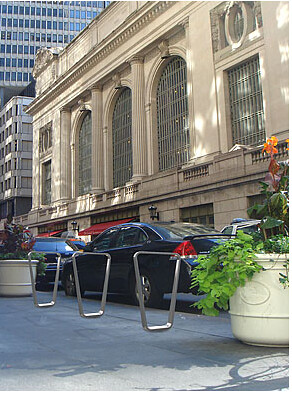
The mark of a good bike rack is that it is art when in use, and art when not in use too…like these bike racks designed by our friends Jacklitsch/Gardner Architects for the NYC DOT City Racks competition in 2008. More on their design here.
Or the ones designed by Jason Farnsworth for the Easton Bike Rack Art Program. More on Jason here.
So after taking a break for Sunday here we are, back again with some fabulous lights for kids rooms. Technically this post should be categorized under Kid Space as well. But it is about light first. So here goes.
We are in love with LIGHTS UP!
Their lamps and fittings are such a fabulous addition to any space. This Brooklyn based company’s fixtures feature regularly as part of designer mood boards (check out their blog here). Interesting twist to the logo: if you look carefully the thing that seems like an exclamation mark at the end is a pull cord to switch lights on and off!!
Their basic fixtures have elegant lines and simple structures, but where they really take off is the vibrant fabrics of the lampshades. Their fabric palette is such that it can suit any taste and become part of any interior space…however you imagine yours to be.
Finally we love the plain ceiling fixtures. Why?

We recently visited the Crayola Factory in Easton, PA (in another post). And now we are itching to paint everything “Macaroni and Cheese” (Yes that is really a color.)
So what happens if you have an inspirational and famous parent? Either you become totally spoilt and squander away their legacy, or you carry their good name forward and make it your own.
The latter is what Katherine Wood of Antonia Tile is doing. Not only has she developed and refined her parent’s work of tile making, she has added to the legacy by introducing enamel tile-making techniques and developing some unique designs.
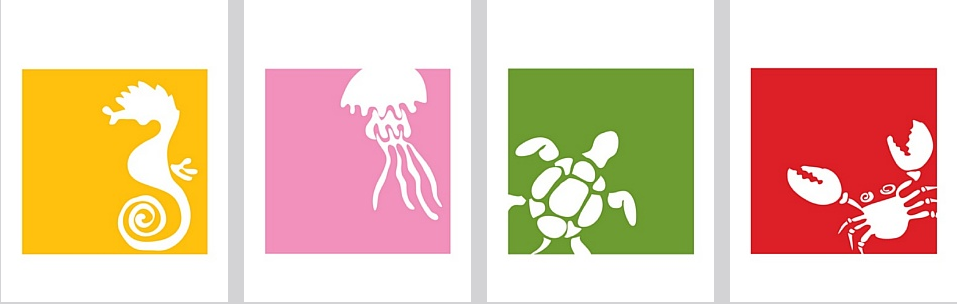
Check out her pieces below. She has an Animal, Nature and Abstract series. She also does custom murals! Definitely a different and “inspirational” piece for kids rooms/bathrooms! “Now remember Arthur, you make that towel rack in my name and do me proud.”
For sale now at MYHABIT: Amazon.com’s new member only designer website. Thank god for our love of books! By default we can use our Amazon.com user info to log on and check out these cool art pieces for kids rooms. Hurry! Sale ends Friday Oct 21st 9pm EST. PS-We are not affiliated with A.com and neither do we profit from making this announcement. We only recognize decent art where we see it!